
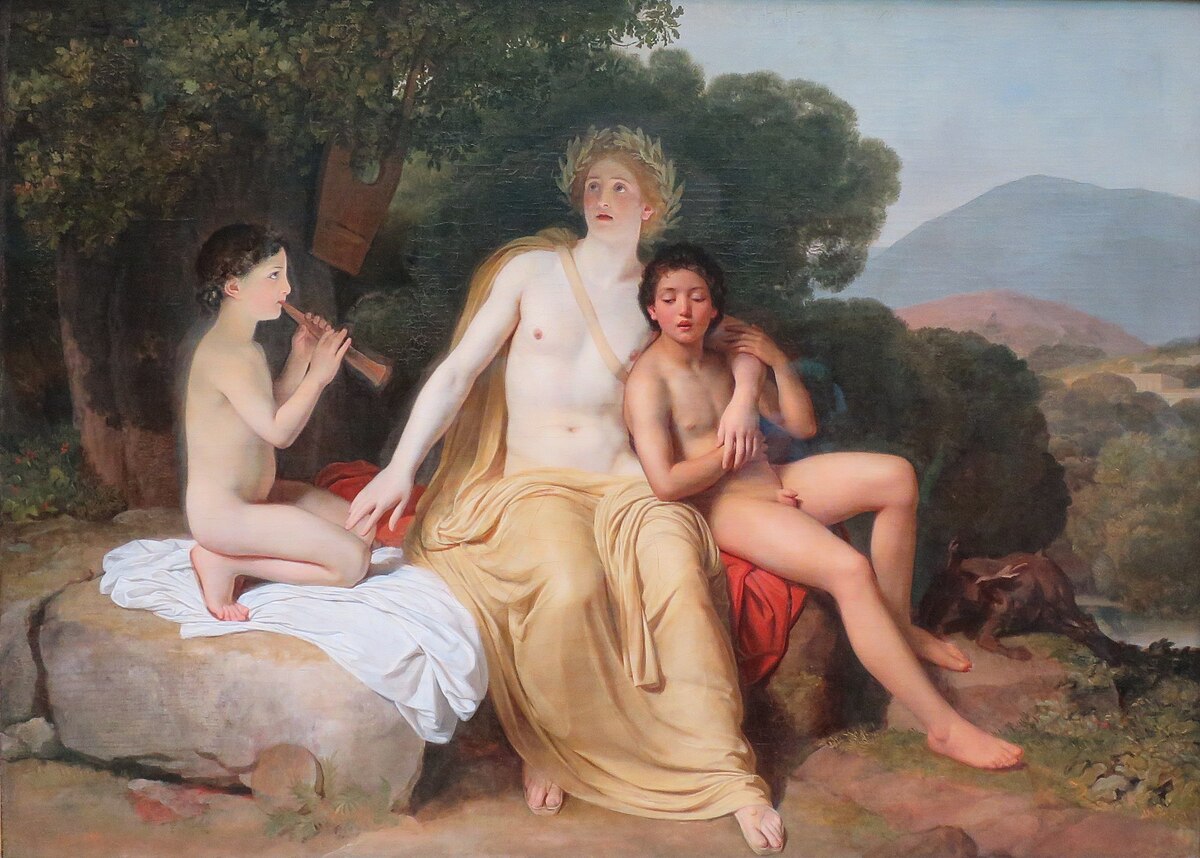
Heterosexuality is the norm for species for which there exist two sexes. The male is attracted to the female; the female, to the male. Egg and sperm unite to create life. This state of affairs applies to humans as well. In the natural order, the man pursues the woman, and the woman confirms her pleasure in being chased by the man. However, although most people are heteroerotic as nature intended, a small portion of humans are homoerotic. If homoeroticism existed without heteroeroticism, then humans would not exist, nor any species that reproduce sexually.
So, what happened? Why do homosexual humans exist at all if they defy nature?
Proper Use of Terminology
Before this aberration is examined, it’s important that terms be defined and used properly. Connotatively, “gay” is a so-called “socio-political identity” that can be used arbitrarily; in other words, “gay” is meaningless fluff. The word can also, more appropriately, mean to be that one is very happy. Therefore, “gay” will not be used to describe these outliers in this post. A “sodomite” is a person that participates in non-genital copulation; that is to say, intercourse that involves either the oral cavity or anal sphincter. A “homosexual” is someone who becomes aroused viscerally by people of the same sex.
Sodomy participants comprise both heterosexuals and homosexuals. So, many homosexuals indeed partake in sodomy, whereas others remain celibate throughout their lives. Some heterosexuals perform dirty sex as well.
It’s imperative that terms be utilized precisely. Many people utter disparaging comments about sodomites and homosexuals. Aversion to the former is justified due to it being a vector for the transmission of infections and damage of anuses. Partaking in sodomy is a moral failing because it causes unnecessary harm.
What Causes Homosexuality?
Now, is the condition of being homoerotic a moral failing? At the very least, it’s a disorder – a psychological one at that.
With all the above out of the way, what causes someone to grow up to become homoerotic? Does a child say, “When I grow up, I want to be attracted to other boys [or other girls]” the same way that said child proclaims its desire to be a firefighter or astronaut. No. The process of becoming homoerotic is involuntary, akin to the process of becoming heteroerotic.
The most significant factor that leads to a boy growing up to become homoerotic, said clinical psychologist Joseph Nicolosi in A Parent’s Guide to Preventing Homosexuality (2002), is the boy’s sense of being rejected by his father or father figure. If a father figure is a disappointment, then the boy will detach from identifying with the masculine role of society. This detachment is a defense against the emotional pain of rejection. The psychological shield the boy constructs inhibits him from fostering friendships with other boys. Unconsciously projecting the inadequacies of his father onto other boys, he keeps his distance from them.
Natural Sensitivity as a Factor
At this point, astute readers will point out the existence of a plethora of boys who have low quality fathers yet still end up exhibiting heteroeroticism as adults. This rebuttal is valid. Dr. Nicolosi stated that, for a boy with an unsatisfactory father figure, the likelihood of becoming homoerotic decreases if said boy lacks a heightened sensitivity, temperamentally wise. The emotional sting will be less piercing than it would for a boy that is constitutionally more sensitive. The naturally tougher boy will seek out same-sex friends.
While many boys are rough, athletic, boisterous, aggressive, and raw, some boys are more gentle, sensitive, intellectual, perceptive, and artistic. Think of the likes of Pablo Picasso, Leonardo da Vinci, Vincent Van Gogh, and Galileo Galilei. Such men were certainly outliers in their youth. Or, more generally, think of painters, sculptors, actors, composers, and chefs. Sensitivity, along with the other “softer” traits, onto themselves, don’t lead a boy on the path to becoming homoerotic if the boy’s father can nevertheless emotionally bond with said boy. However, if the father rejects the “soft” traits, then the boy is more liable to experience homoeroticism as an adolescent and adult.
Prehomosexual Indicators
Boys rejected by their fathers tend to not get along with their male peers. There are two variations of such boys – those with Gender-Identity Disorder (GID) and those who are gender non-conforming. The former includes flamboyant, effeminate boys that act overtly like girls – putting on dresses and lipstick, playing with dolls, wearing pink, stating to be “girls trapped in boys’ bodies,” limping their wrists, hanging out and gossiping with girls, etc.
Dr. Nicolosi noted that part of the normal identification process is the self-segregation of boys and girls. “Eww, girls are gross!” “No BOYS allowed!” This separation occurs during the Freudian latency period of development.
The latter, for which the signs of potential future homoeroticism are much harder to detect due to being more subtle, are boys that don’t act like boys, but don’t really act like girls either. Such boys tend to be loners or those that hardly interact in their friend groups. They have difficulty being assertive, confident, and daring. They are imaginative and tend to self-isolate.
Unmet Needs
Due to not fitting in with other boys, both of the aforementioned disordered types of boys retain a longing for masculine camaraderie that is continually unfulfilled. Unmet developmental needs don’t vanish. They are instead distorted into pathologies. The unquenched longing for male bonding in a boy is converted to homoerotic strivings once the boy reaches puberty. Therefore, the homosexual is simply an individual that is emotionally stunted.
This applies also to females, for which Dr. Nicolosi reserved a single chapter. However, Dr. Nicolosi’s main focus was on prehomoerotic boys.
Nature vs. Nurture
The hypothesis that a “gay gene” exists is easily refuted by the existence of identical twins for which one twin grows up to exhibit heteroeroticism and the other grows up to exhibit homoeroticism. This phenomenon in which twins aren’t of the same sexual orientation occurs in over 60% of identical twins, as observed by Neil Whitehead. That only one identical twin in a pair ends up experiencing homoeroticism has more to do with how said twin experienced his early childhood environment.
Homoeroticism in non-human animals is generally linked by biologists to the stresses of captivity, environment pollutants, juvenile sex games, unavailability of the opposite sex, hormonal issues, expressions of dominance, misinterpretation of odors, and domestication.
Abuse can increase the likelihood of developing homoerotic strivings as well. In Edward Laumann’s major 1996 study known as “Social Organization of Sexuality”, it was found that childhood sexual molestation increases the likelihood of a child growing up to homosexual by a factor of three.
Prevention of Homosexuality
Dr. Nicolosi stated that the prevention of male homosexuality begins when a boy is about 18 months of age. In fact, the critical period ranges from the age of one and a half to three years of age. During that time, a father’s duty is to demonstrate his affection and care for his baby or toddler boy. Mothers display this through cuddling and nursing. Fathers, on the other hand, display this through rough-housing and wrestling. Physical play acclimates a baby or toddler boy to handle aggression and be comfortable with his body. This adjustment helps the child later identify with the masculine, which in turn helps the child bond with same-sex peers, which in turn leads to heteroeroticism as an adolescent and adult.
The issue with American culture, as observed by Richard Wyler, is that “real men don’t touch each other.” This distortion leads to boys being touch-deprived. In a culture like America, it is considered “gay” for male friends and family members to affectionately hug, hold, or touch each other. The fear of appearing to be homosexual ironically produces boys that end up becoming homosexuals. Many homoerotic men are simply men that long to be held by another man. The longing exists when the men are boys and lingers into adolescence and adulthood.
Although the critical range preventing homoeroticism in boys is from 1 ½ to 3 years of age, it’s possible to help a boy that is between 4 and 12 years of age as well. Overbearing mothers can help boys as well by backing off and allowing the boy to pursue challenges. Many old-school psychoanalysts blamed such oversolicitous mothers for causing their boys to become homoerotic. However, some mothers of prehomosexual boys are rather cold, aloof, distant, and hands-off. Nevertheless, virtually all homoerotic men as youth had poor, or at best mediocre, relationships with their fathers, as observed in Freud Scientifically Reappraised (1996). Fathers of prehomosexual boys tend to be fathers that outsource the entirety of childrearing to the boys’ mothers.
“Your mom will handle it.”
“Leave me ALONE, godd*mmit! I’m watching the game!”
“Kids are women’s work.”
“Kids are to be seen, NOT heard.”
After work, these fathers typically go straight to the television and veg out on the couch. They hardly bother to spend quality time with their boys on the weekends. Such fathers tend to be stiff and emotionally sterile. The mothers respond to this by using the male children as surrogate husbands to fulfill their emotional needs. A mother like this ends up putting her emotional needs before those of her child(ren). This is dysfunctional behavior and only confuses the child, who is biologically wired as a young mammal to expect proper soothing. This confusion leaves the child in a state of chronic uneasiness. Instead of calming the child down, the fathers only worsen the stress that the child experiences by antagonizing said child.
A boy needs to know that he is loved by his father. This knowledge can’t merely be intellectual – “I have a roof over my head, clothes on my back, and food on the table.” The child must viscerally sense and emotionally feel that he is loved. The knowledge must be held somatically in the viscera, not only linguistically in the frontal lobe. Only then will the boy construct a schema in his mind that being a male and with other males is desirable. Fathers must be both benevolent and strong. Growing up straight requires being close to other males. The ability of a boy to bond with other males is greatly influenced by the template he has of his father; and, more abstractly, the masculine in general.
Unlived Lives of Parents
At this point, we can compare and contrast the observations made by Dr. Nicolosi to those of other psychologists, starting from when, or even before, a boy is born. The renowned Swiss psychologist Carl Jung urged husbands and wives to exercise the courage to live their own lives fully before having children. In Collected Works of C.G. Jung, Volume 17: The Development of Personality (1954), it is stated that children are unconsciously driven to behave in a manner that compensates for the unlived lives of their parents. Prudent, overly strict parents tend to have children that are seemingly compelled to behave degenerately. A sloth of a father may have a son that is industrious at the expense of the latter’s health.
The worst results stem from parents that keep themselves artificially unconscious so as to not burst the illusory bubble of a “good marriage.” The mothers of such marriages, as also noted by Dr. Nicolosi, treat their sons like husbands. The worst outcome of this treatment is that the son grows up to become homoerotic. This homoeroticism wards off memories of incestuous feelings from the mother. A more favorable, but still nonetheless lackluster, outcome is that, in spite of becoming heteroerotic as nature intended, the boy ends up choosing mates that aren’t complimentary to his own personality. Such a boy may end up with a wife he’s always bickering with or a wife that he allows to control him, be that domination overt or covert.
Development of Coordination
It has been mentioned by Dr. Nicolosi that prehomoerotic boys are generally less athletic than preheteroerotic boys. The inferior coordination of prehomosexual boys can be attributed to the lack of love in their environments. Akin to how an animal has a sixth sense that tells it if a dangerous predator is not too far behind, a baby can sense the amount of love emanating from an environment.
Coordination, said Alexander Lowen in The Language of the Body (1958), develops not in a vacuum, but in an environment with an abundance of love. To the degree that love is insufficient, the child inhibits its body, similar to how a Burmeister leaf frog of Brazil plays possums upon feeling threatened. Using a car as an analogy, think of vital action as the pressing of the accelerator, and complete immobilization as the pressing of a brake pedal. Imagine that the accelerator and brake pedal are pressed simultaneously as a metaphor for the inhibition the child experiences. The car metaphor is commonly used by somatic practitioners.
Oral Characters
Prehomosexual children tend to go through bouts of depression. This occurrence overlaps with the observation that Lowen made with regard to children that are orally deprived. Said observation alludes to the psychosexual stages postulated by Sigmund Freud to exist due to his analysis of his patients’ dreams. Since dreams are abstract and often random, the temptation to be dismissive of the existence of such stages is reasonable. However, Lowen, unlike Freud, analyzes the physical bodies of his patients. The mind and body are one. A person’s posture, mannerisms, gait, musculature, and voice provide lots of clues to said person’s character independent of the content of his speech.
The “oral character” is a person who is fixated at the oral stage of development. Such a person, as a baby, decided to suppress its oral erotic needs before such needs were satisfied. One of Lowen’s “oral character” patients impressed said analyst with the following characteristics: depressed sternum with outward flare in the lower ribs resulting in a chicken-breasted appearance, elevated shoulders, a deflated thoracic cavity, a soft belly without turgor, and an undercharged body.
Depleted Energy
Even among people of the same “character,” there will be slight to moderate variations in body composition. All oral characters nevertheless have undercharged bodies. Adequate nursing of a baby not only provides it with nutrients, it also strengthens its neuromuscular system, preparing it to hold greater charge. Energy flows through all of us. Think of the bodies of orally fixated individuals as weak capacitors that fail to withstand a high amount of charge due to damage. Lowen said that this charge flows up and down the body like a pendulum swings left to right. A strong charge anchors a person to the earth. This enables a person’s feet to be planted on the ground, both literally (neuromuscularly) and metaphorically. Such a person possesses the solidity to tackle life. A ripe raspberry is ready to land on the ground to begin the new chapter in its life; whereas an unripe raspberry is resistant to falling to the ground, becoming bitter if it is pulled from the woody stem.
Oral characters are people who were plucked out of the mammary gland too soon. There is certainly an overlap between Lowen’s “oral patients” and prehomosexuals. In other words, some oral characters are prehomosexuals, and some prehomosexuals are oral characters.
No Latency Period
After a child is young, it moves on to the latency period, during which it becomes apathetic, if not repulsed, by members of the opposite sex. When Dr. Nicolosi used the term “latency period”, he was referencing traditional Freudian psychology. Interestingly, a student of Freud, Wilhelm Reich, challenged Freud’s conception of the so-called “latency period,” stating that such a period is a product of civilization, not biology.
In The Function of the Orgasm (1927), Reich used a culture based on islands located near Papua New Guinea to disprove the biological existence of the latency period. These coral formations are collectively called the Trobriand islands. In said culture, children gratify themselves sexually throughout all stages of life. Boys and girls play sexual games with each other without partaking in the act of sex. Like children in our culture, Trobriand boys and girls will separate. The boys will travel deep in the jungle to scout for items, and the girls will stay behind and socialize with each other. However, unlike Western, Oriental, or any other post-nomadic children, these islanders never behave antagonistically towards the opposite sex. The “girls rule boys drool” and “girls STAY AWAY” type of mindset is foreign to the islanders.
Islands Free of Pathologies
Among the islanders, homoeroticism among adults is virtually nonexistent. Any of the extremely rare homosexual adults of the island are viewed as unfortunate, arrested individuals by their fellow islanders. Also, the mental states that Freud classified as “neuroses” – psychoneurosis proper, character neurosis, erotic fixations (including oral), actual neurosis, psychoses, perversions, to name some – are almost nonexistent among the tribe members as well.
The exception to this avoidance of pathologies are the Trobriand children that are prepared for pre-arranged marriages that are economically advantageous. Those children, like those in more advanced societies, develop defective mental states like chronic anxiety and depression.
The Life of a Trobriand Boy
Trobriand islander children grow up not in any nuclear family setup, but among their extended families in clans. A Trobriand child is raised by its mother and maternal male relatives. Boys typically look to such relatives for guidance towards fulfilling the male role of their society. The maternal uncles, male cousins, and grandfather teach the boy to fish, hunt game, create spears, dance to woo Trobriand females, fight off predators, etc.
Families are not isolated from each other in houses. They spend their lives together by the hundreds. Therefore, even if a Trobriand boy’s mother or uncle happen to be inadequate, such a boy can easily find another male to model after. He’s not trapped in a house for hours at a time like children from more advanced societies.
The Homosexual’s Hatred Towards Women
In The Voice of the Body (2005), Lowen stated that the homoerotic man harbors deep feelings of hostility towards women in general, even if he behaves in an affable manner towards them on a superficial level. The presence of women subconsciously reminds him of his disgust as a baby with the subliminally incestuous style of being handled by his mother. The mothers of prehomosexual boys, said Lowen, are emotionally immature and disturbed.
To numb the constant, acute surge of sexual feelings he could not contain, the prehomoerotic baby deadened his body. His parasympathetic system was excessively active. He was so shocked by lack of proper orientation with his mother that he was unable to cry.
Latent Homosexuality
Homoerotic urges, argued Lowen, can be either manifest or latent. So far in this post, manifest homoeroticism has been described. The extent that an individual is not sexually gratified corresponds to the extent that said person has encapsulated homoerotic drives. The maximal, “perfect” level of sexual gratification is called “orgastic potency.” Hardly anyone in post-nomadic societies would be approximated to be “orgastically potent” by Lowen or Reich. Thus, almost everyone in our modern society is a latent homosexual to one degree or another.
Men who fear giving or receiving affection from another man betray a latent homosexual attitude. Domineering, oppressive men who think of the feminine as inferior as opposed to complimentary reveal themselves to be latent homosexuals. “Happy wife, happy life” servile lap dogs that put their wives on pedestals are latent homosexuals. Pornography audiences are all latent homosexuals. None of these men are sexually gratified.
Women can also be latent homosexuals. A “loose” woman is no more sexually gratified than a celibate Catholic nun. It is, said Reich, precisely because of this absence of sexual gratification that a promiscuous woman behaves indiscriminately in the first place, contrary to the conclusions that would be formed by taking the activities of such a woman at face value. Through the inspections of peoples’ somas (again, mind and body are one), Reich and his associates observed that a person with a healthy, unblocked, wave-like pulsation of “orgone” (libidinal energy) is sex positive but selective.
Proper Maturation
Proper maturation demands that the germinating manhood of boys and womanhood of girls be cherished. This means that their developmental needs ought to be met throughout the entirety of their childhoods, from conception to adulthood. Boys and girls need to be allowed to blossom without disastrous disruptions, just like the buds of a plant need to be allowed to bloom into pedals. The apple that falls from the tree too early is a sour apple that is spit out by animals.
Treatment for Homosexuality
Is it possible for homosexual men to eliminate homoerotic urges and develop heterosexual urges? Yes, but it’s by no means easy. This endeavor will require lots of self-honesty and discipline. The most important ingredient that helps spur change is desire. The homosexual man must genuinely want to change for his own sake, not merely to fit in socially or for other people.
Logistically, the first action the homosexual man must take is to not give into his homoeroticism. He must stop behaving as a sodomite and seeking out other men as sexual partners. He then needs to build platonic relationships with other men. Merely acquainting himself with other men is not the hard part. The challenge will be to get himself to “click” with them. People bond best with those who understand them and those they understand. A man that has, independent of any premeditative foresight on his behalf, grew up to be heteroerotic will have difficulty comprehending a man who, also without voluntary consent, grew up to become homoerotic. A person’s sexuality is a deep part of who he is.
Understanding this difficulty, and with great sympathy towards homosexuals who ceased being sodomites, Dr. Nicolosi suggested that those struggling with a homosexual problem seek group conversion therapy. It is, at the very least, an opportunity for the man to emotionally connect with other men facing the same challenge. Dr. Nicolosi also suggests that the homosexual man attend one-on-one therapy sessions with a therapist who understands that homosexuality is a defect. Such a therapist, if competent, will be able to provide proper perspective, along with the emotional containment the homosexual received poorly during childhood.